In a nutshell
- 🧰 Use rubber bands to create flexible tension-based dividers that curb item migration, add friction, and can double usable drawer space in minutes.
- ✍️ Step-by-step: audit contents, place adhesive hooks as anchors, stretch bands into parallel rails or quadrants, then fine‑tune with extra bands and labels for a custom, modular layout.
- 🧪 Choose smart: thin bands for precision, wide bands for grip, natural rubber for elasticity, silicone for moist areas; use low-profile, clean-release hooks to protect rental surfaces.
- 🔒 Safety and longevity: avoid overstretching, add clear tabs to prevent scuffs, rotate bands quarterly, wash silicone bands, and upgrade with eyelets or mini tension rods for a sturdier finish.
- 🚀 Big wins: cheap, reversible, and modular; keeps items upright, speeds routines, and scales from kitchen to desk to bathroom without permanent fixtures.
Decluttering a chaotic drawer often feels like a weekend project, yet the simplest fix costs pennies and takes moments. With nothing more than a handful of rubber bands and a little ingenuity, you can corral socks, utensils, chargers, even beauty bits, into crisp lanes that stay put. The trick is leveraging tension and friction to create instant, flexible dividers that adapt as your storage needs change. This quick hack can double your usable space in minutes, because items no longer sprawl or overlap. It’s renter‑friendly, reversible, and oddly satisfying. Ready to turn rummaging into a single smooth motion? Here’s how to start a rubber band revolution in your drawers today.
Why Rubber Bands Transform Drawers
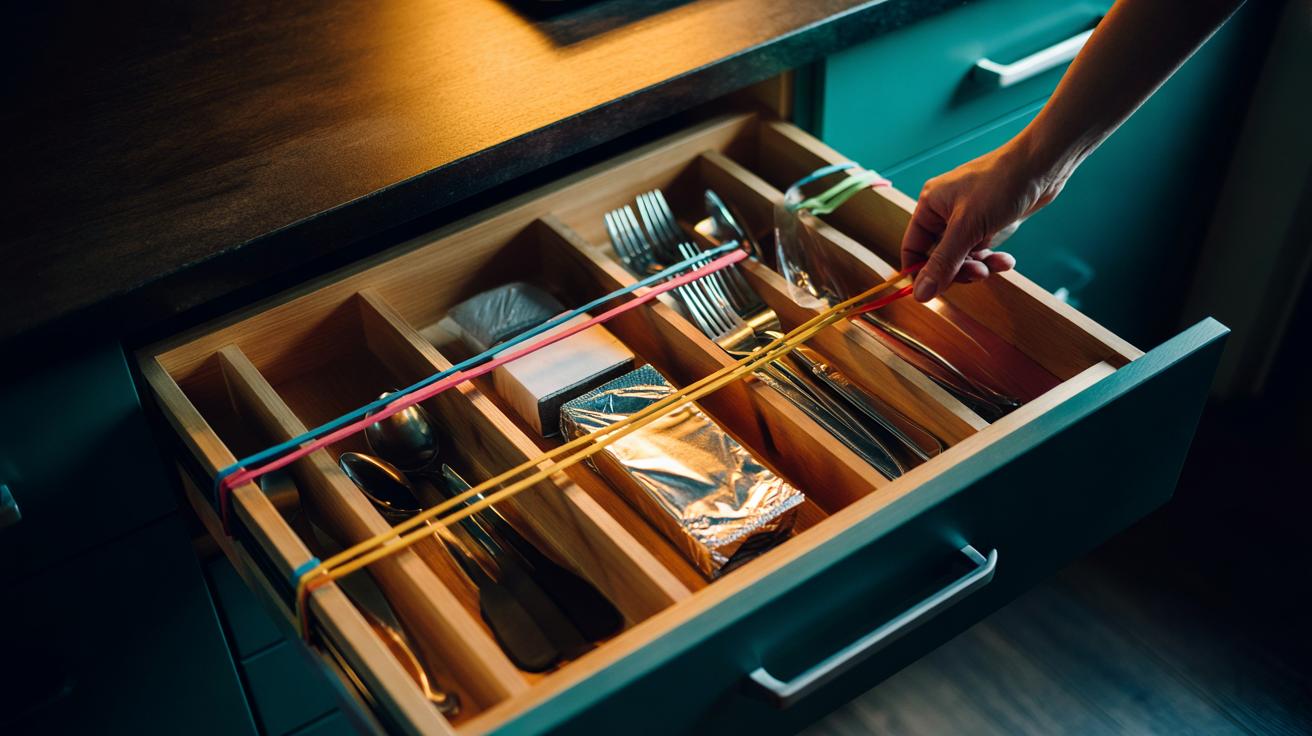
Drawers fail not for lack of space but because space isn’t shaped. Traditional trays carve out rigid rectangles, which rarely match what you own. Rubber bands solve the geometry. Stretched across side walls or around short dowels, they create tensioned lanes that hug contents and remove the dead air between them. When objects can’t migrate, you reclaim the space that disorder steals. A single band also adds micro-friction, so slippery items—cables, makeup brushes, pastry tips—stop sliding with every open and shut.
The result is more than tidiness. By holding items upright and in place, you can stack vertically without collapse. Think rolled socks filed like records, or foil and parchment standing instead of sprawling. The system flexes: widen a lane by moving a hook, tighten it with a second band, or add a cross-band to create quick “cells.” Modularity is the win. You’re crafting storage that adapts on the fly as your kit changes from season to season, or as children nick the odd spoon.
Crucially, this is reversible and tool-light. If you’re renting, or just indecisive, nothing is glued or nailed. Remove bands, wipe the faint line, and the drawer resets to neutral, ready for its next life.
Step-by-Step: Create Instant Dividers
First, audit the contents. Group by size and frequency: daily-use in front, occasional at the back, bulk along one side. Measure your internal drawer width and height; note any runners or lips. The aim is to build lanes that fit your stuff, not force your stuff into the lanes. Keep a small pile of assorted rubber bands—thin for finesse, wide for grip—plus four stick-on hooks or drawing pins if your drawer allows.
Next, set your anchors. For a no-damage option, place two adhesive hooks per side, opposite each other, about a third from the front and back. Stretch a band across each pair to form parallel rails. Slide items in: utensils, stationery, or rolled tees. For deeper drawers, add a central cross-band to create quadrants, ideal for cables and adaptors. If you have wooden sides and don’t mind tiny pinholes, drawing pins let you angle bands diagonally for custom cells around awkward items like whisks.
Finally, fine-tune. Double up bands where tension feels weak. Add a short band looped around a rail to clip a rogue charger. In under five minutes, the drawer stops being a jumble and becomes a grid. Label the front lip if you like—small vinyl letters or a wax pencil—so any family member can reset order in seconds.
Picking the Right Bands and Tools
Not all bands behave the same. Wide bands (20–30 mm) spread pressure and grip smooth plastics; thin bands thread neatly and create precise lanes for cutlery or makeup pencils. Choose natural rubber for elasticity, and avoid perished bands that snap under stretch. For damp kitchens, silicone bands resist moisture and odours. Hooks should be low-profile and rated for paintwork; in rental homes, stick with removable adhesive options marked “clean release”.
| Band Size | Width | Best For | Notes |
|---|---|---|---|
| Small | 3–6 mm | Pens, cutlery, makeup brushes | Precise lanes; double up for strength |
| Medium | 10–15 mm | Cables, socks, utensils | Balanced grip and flexibility |
| Wide | 20–30 mm | Food wraps, tools, odd-shaped items | Spreads pressure; kinder to surfaces |
| Silicone | Varies | Bathrooms, kitchens | Moisture resistant, easy to clean |
Match band tension to the heaviest item you’ll store. If a whisk can wriggle, add a second band or reduce the span between anchors. Keep a small stash of spare bands in the back corner so replacements are always to hand when one tires.
Safety, Longevity, and Smart Upgrades
Protect the drawer first. Where bands touch painted or veneered sides, add a tiny clear tab—cut from a document wallet—or a dot of furniture wax to reduce scuffing. Never overstretch bands more than double their resting length; they’ll fatigue faster and can snap unexpectedly. In homes with children, keep bands taut and tucked so little fingers can’t pluck them like a guitar. If in doubt, choose wider bands at lower tension.
For longevity, rotate bands quarterly and give the drawer a five-minute reset. Dust, crumb, wipe, replace. Kitchen drawers benefit from a quick wash of silicone bands in warm soapy water; air-dry before reassembly. If your setup is working a treat, consider a subtle upgrade: swap hooks for low-profile screw-in eyelets in wooden cabinetry, or use mini curtain tension rods as front-to-back anchors that carry bands at perfectly even heights.
Want a premium finish? Wrap a band around a short bamboo skewer to create a cushioned mini-rail, perfect for delicate items like glass droppers or pastry nozzles. The principle remains the same: tension shapes space. Once you learn to guide objects rather than stack them, the drawer doubles itself, and your morning routine halves in time.
By turning a chaotic cavity into a guided grid, rubber bands deliver fast, flexible drawer storage that grows with your life. It’s cheap, reversible, and surprisingly robust when tuned to your items. Try one drawer, then roll the trick across the kitchen, bathroom, and desk, refining tension and layout as you go. Small forces, thoughtfully applied, create big order. What’s the first drawer you’ll transform today, and how will you adapt the lanes to fit your exact daily essentials?
Did you like it?4.5/5 (29)